Saints and murderers – beware the trappings of Christianity


Mary MacKillop holding her life orders.

The trappings of Christianity are precisely that, a trap – just ask Teresa Lewis or Mary MacKillop.

When we adhere outwardly, publicly or religiously to Christian faith but deny its inner, personal change, eventually we – and others – are snared in a trap of our own making.

What tends to happen is that the appearance of being a good Christian becomes an ever broadening disguise, hiding the real turmoil within. We would have been better to deny the appearance and be honest about the reality.

As guilt and condemnation do their insidious work, and as we have more to lose if our charade is exposed, we work harder on the exterior, becoming even more lost on the inside.

Jesus gave the simple example of the religious leader coming to pray, full of hubris, flaunting his religious superiority but in reality being further away in God’s eyes than the scorned tax collector who stood at a distance, ashamed of his wrong-doing, and seeking mercy and forgiveness.

Extreme examples in today’s world come to light with the execution of a US woman and the one-time excommunication of soon-to-be-Catholic-saint, Mary MacKillop.

Teresa Lewis was executed in Virginia on Friday afternoon (AEST) fo arranging the killings of her husband and a stepson over a $US250,000 insurance payment.

Amazingly, Lewis had the appearance of a strong Christian and even prayed with her husband in bed before getting up and unlocking the door of their home to let in the killers.

The Sydney Morning Herald reports that Lewis admitted her life had been marked by outrageous bouts of sex and betrayal even as she ‘hewed to the trappings of Christianity’.

‘I was doing drugs, stealing, lying and having several affairs during my marriages,’ reads a statement by Lewis. ‘I went to church every Sunday, Friday and revivals but guess what? I didn’t open my Bible at home, only when I was at church.’

Which is why a Christian life marked only by ‘meetings’ is not a true marker of discipleship. Jesus said that while we would find his presence in the company of other believers, so too among the poor, in serving others and in a heartfelt searching of our own hearts.

Mary MacKillop by all accounts was someone known for these qualities which is no doubt why she was responsible for exposing the paedophilia of a priest, and then excommunicated for her troubles.Read More »

Suffer into Freshness

I wrote this poem on my phone, hence the short lines and meter. Clearly some angst on this particular day…

Suffer into Freshness

Is there a faith that is safe
From fading vacuous jargon
And well-intentioned simpletons
Who trample through the garden?

The further I remove myself
From religious ways of thinking
The more I notice emptiness
And sentiment that’s sinking.

Is this a sign of my decline
Into a heart that’s hardened?
Or a clearing of my sight
To metamorphing pardon.Read More »

Kill the church but go easy on the gurus…

As a wobbly sounding plane flies over head through the cloud and light rain of an early Leichhardt morning, I consider another staple of inner west life, the Inner West Courier.

It has thrown up a spiritual conundrum, a coded message of religious reality in our time. Actually, it’s just demonstrating the bleeding obvious…

On page 12 of the August 31 edition, a story celebrates the awarding of the Australian Writers Guild Kit Denton Fellowship Award to Petersham resident George Casti for his script I Want to be Slim.

Great, I think. Good to see some local talent being rewarded and $30,000 can make all the difference as a writer seeks to stave off poverty and establish their craft.

I read on to see what his script is about: ‘…award judged on courage and excellence… Catsi’s “anti-Hillsong” script won… religion is a very polarised area… satirical script is about the Rev Slim Limits and his performance in getting the masses to follow his evangelical ways.’

Mmm, so George gets $30,000 to perfect his script, poking fun, in a courageous and excellent way, at a section of society that, obviously, it is perfectly appropriate to ridicule. The Courier report is matter-of-fact, as if we shouldn’t be surprised that a local church is award-winning, satire material.Read More »

Fake men, lots of kids and not enough housework…

Sydney Opera House with a tall ship in the for...
Image via Wikipedia

The Opera House was a dangerous idea in its time and so it is fitting hat it hosts the Festival Ideas of Dangerous Idea in early October.

Having argued that there is no more Dangerous Idea than Jesus, let’s check out a few of the less dangerous ideas under consideration at the festival: Are all men fakes?; Why the religious will inherit the earth; and Australian husbands are the worst in the world and why it’s women’s fault.

Oh, and at the end of the story, check out my ‘Biblical perspective’ on the ‘dangerous ideas’ covered…Read More »

How to cast the perfect vote… and not cast the first stone

Australian and I Vote
Hands up who votes for Australia?! Image by Stephen Mitchell via Flickr

Many Australian voters will be hoping to cast the perfect vote on Saturday – one that represents the best policies, the best candidates and the best future for themselves and the nation.

Christians, and many other thoughtful people, are trained to be intentional and purposeful in all that they do, conscious of rights and wrongs and doing what is best in the eyes of God or their own conscience. This brings a kind of moral pressure to bear as we sift through the competing arguments from candidates and commentators alike.

Sometimes casting a vote almost becomes a battle to see who will cast the first stone – is there any among us worthy to pass judgement on the poor, political sinners scrambling exposed in the dust?

The hard, but relieving, truth is that the perfect vote does not exist, and never has because none of the parties or candidates are perfect. So if perfection is your goal, your are looking in the wrong place. I can think of Someone perfect, but He doesn’t need your vote. He would appreciate a chat though…

So take the pressure off, sit back and read my summary of the various options based on years of journalism and a relentless reviewing of parties, policies and posting more than 110 articles on the election in the past two months. 

 Oh, and one thing I won’t be doing is telling you how to vote… That’s your decision.

Visit Australian Christian Voter to read the full article.

Related Articles

Chattering and tractoring classes worlds apart on election day

In the inner Sydney seat of Grandyler where I live we have as a choice of candidates, starting on the left:  two varieties of socialists, the Greens, a rare Democrat sighting, the sitting Labor member and a Liberal candidate who is so young that the picture of youths being sent off to war as canon-fodder comes to mind.

Compare this to, say, the rural NSW seat of Riverina and you have, starting at the right: One Nation,  Independent, Christian Democratic Party, Family First, Liberal Democrat, Nationals, Liberals, Labor and Greens although there may be some discussion as to the relative ‘rightness’ of some of these candidates.

In other words, we have remarkably different worlds just a few hundred kilometres apart. It’s a common divide between the city and the bush and grows wider with relative distance from major city CBDs.

While there are overlaps and exceptions, we would do well to understand and respect the differences in priority and perspective between the inner city ‘chattering classes’ and the rural ‘tractoring classes’. 

One lesson is that the Greens have taken a step up from being a minor party that falls into an organisational hole when elections drawn near. They are mobilised even in electorates where they have more chance of being mistaken for a vegetable than winning.

If parties such as the CDP or Family First aspire to real political influence they must find their support base, represent it powerfully and broadly and do the hard yards of political foot soldiering.

As for making sense of it all, an election article of mine has been published in Sight Magazine or visit my Australian Christian Voter blog to find a link and vote in an election day survey – what’s your tip for election day?

To be beheaded, and satisfied…

Back in the early 1990s when I started out in pastoral ministry and church leadership there was a popular teaching used to inspire Christians to greater heights of service and vision.

‘There came a man sent by God, and his name was John’ reads John 1:6, speaking of John the Baptist.

We were asked to replace the name ‘John’ with our own to encourage us to believe we too had been called by God to do great things. Just as John the Baptist strode out into the Jordan and Judea in response to the call of God, so to we would make our mark on the world.

Of course there is a fine line between an ultruistic desire to change the world and egotistical need for recognition and I’m not entirely sure which was more developed by this reference.

That is not to say that God does not call people and that we should not have an unaffected, humble and life-changing sense of the purpose of God in our lives. Each one of us is significant beyond our comprehension, in terms of our seen and unseen influence on others but mostly because we matter to God.

But I don’t recall us, as we discussed this verse, following on from this starting point with John the Baptist through to the outcome of his call. John lived in the desert, wore animal skins, ate locusts, languished in prison, watched his finest disciples leave to follow another and was beheaded.

While Jesus called him greater than any Old Testament prophet, his entire ministry was designed to make way for another. One of John’s best known statements was that Jesus should become more, and himself less.

Serving God is ever the selfless act and if we substitute our own ambition for his glory we cross over into something different.

None of us carry off selflessness to perfection – even John the Baptist acknowledged a gradual retreat of his own name and a rising up of Christ’s. And many of us forget selflessness altogether and pursue ministry for selfish gain, cloaked in a spiritual mantle.

The telling will be in our ability to lay it down and celebrate its picking up by another. To be beheaded and satisfied that we have done well is the mark of Christian greatness. Now there’s a line we don’t see too often in leadership classes… PH

PS There might be something in this post for Kevin Rudd??!!

Social engagement not just for the few

Scott Stephens is probably a good bloke doing a hard job, as editor of ABC Online’s Religion and Ethics portal.

But his July 19 blog post pretty much wrote off any Christian that engaged in politics (except maybe those he agrees with) and was full of stereotyping, arrogance and perhaps a slight trace of envy.

We are all good at that, if we are honest, aren’t we? So lets pray for him as on balance it is a positive thing that such a forum exists and a Christian is the editor.

His post attacking the Australian Christian Lobby, and among other things, Hillsong, gave the impression that unless you are a trendy, left-wing intellectual who reads Eureka St you shouldn’t climb the ivory tower of social engagement for fear of embarrassment.

That’s a pity because what we really want to do is educate Christians about social engagement, for the sake of the gospel, and the best way to do that is for us all to have a go, get kicked in the head a few times, learn some lessons, grow in humility and wisdom, and keep going…

Check out my response to his post.

Practical tips to avoid information overload

Futurist Alvin Toffler popularised the term ‘information overload’ in his book, Future Shock, written in 1970. He highlights the negative impact of vast amounts of information on making decisions: ‘When the individual is plunged into a fast and irregularly changing situation… his predictive accuracy plummets. He can no longer make the reasonably correct assessments on which rational behaviour is dependent.’

Read more at Suite101: Practical Tips to Avoid Information Overload.

Politicians fail to deliver on asylum seeker policy

Check out some comment on the asylum seeker issue I’ve made on my other blog, Australian Christian Voter.

Christians, along with just about every other section of the community, are divided about how best to respond to the arrival of refugees by boat.

The politicians have no hope of coming up with cohesive policy because they are playing to political audiences. But Christians are often not much better, sniping at each other from behind entrenched views.

If a forum of Christians across a variety of perspectives could provide a united voice, we might actually lead the nation in a prophetic way. We need national Christian leadership to do this – it’s there I’m sure but where do we find it? PH

Gretel, Gillard and ‘god’ in an age of convenient Christianity

Gretel Killeen is now a columnist for The Sun-Herald and, I believe, we did the same communications degree too long ago to remember. Known to most as the host of Big Brother for many years, she is actually an acclaimed author in various genres and did time as a stand up comic.
She counts her most important achievement as being a single mother to her two children and apparently believes in a small ‘g’ god, whatever that means.

Gretel made a fairly intelligent contribution in Sunday’s column to the commentary on Prime Minister Julia Gillard’s declaration of non-faith:

‘And despite the fact I do believe in a god, I’d like to give praise… to Prime Minister Julia Gillard for declaring her atheism last week. In a hypocritical world, it’s not uncommon for allegedly God-fearing politicians to treat the Ten Commandments as though they were a smorgasbord rather than a set meal, choosing their own custom-made combinations to both impress others and serve themselves. It’s therefore thrilling in this age of convenient Christianity to hear someone tell the truth on an issue that could actually lose them votes.’

If she was seen wearing sackcloth and ash and saying some of those things, especially ‘Ten Commandments as… smorgasbord’ and ‘impress others and serve themselves’ we might easily mistake her for Joan the Baptist.

It is possible (and not mutually exclusive) to respect the honesty of a Prime Minister and the measure of faith of a newspaper columnist while still earnestly praying that they would both encounter the living Jesus. PH

Gillard: trust, consensus and sleeves rolled up

In announcing today a breakthrough agreement over the controversial mining tax, Prime Minister Julia Gillard emphasised consensus over confrontation and ideals such as trust and hard work. She also made a point of sharing the glory with her colleagues Wayne Swan and Martin Ferguson.

While she may have moved away from an early faith in God, it would seem she has gained some positive values from her Welsh Baptist upbringing. It remains to be seen how some other influences on her life will come to the fore.

For details of the mining tax outcome and to hear Julia Gillard answer the question, ‘Do you believe in God?’ check out my other blog  Australian Christian Voter.

Julia learned Bible verses but formed different views

Faith in politics is much more on the agenda in Australia than it was a decade ago and so it is no wonder there has been intense interest as to the religious convictions, if any, of new Prime Minister Julia Gillard.

Today she was directly questioned about religious faith and the future of the Christian vote in Australia during an interview on ABC Radio.

The Australian newspaper reports that Ms Gillard appeared to be ‘surprised’ when asked whether she believed in God and how she would court the Christian vote.

‘I’m not a religious person,’ Ms Gillard told the ABC, although she was quick to point out she had won a prize for learning Bible verses as a child in the Baptist Church. ‘I’ve, you know, found a different path.’

Read more of what she had to say at Australian Christian Voter.

God dethroned, humanity is next

The ABC’s Q and A program last night gave a rare display of the logical outcome of secular humanism.

Having begun discussing the relative merits of saving whales verses chickens, the show ended, under the guidance of unethicist Peter Singer, considering that it might not be so bad for humans to have sexual relations with their pets.

While most people on the panel and in the audience couldn’t even engage with that outrageous final topic, it did show us where popular secular thinking is taking us.

Having dethroned God, the next logical step for secular atheism is to dethrone humanity. If there is no God to say that human life is sacred, made in His image, then people are just animals, right and wrong mean nothing and euthanising children and oral sex with dogs is acceptable.

If you don’t believe me, read the transcript. It happened on national television and while hugely offensive, was at least an honest viewing of the dismal trajectory of the thinking of Singer and the secularists.

If you have been flirting naively with some of their ideas, take a good look at the whole murky monster and flirt no more.

Ethic classes – ‘new atheism’ in poor disguise

As the debate rages over the trial of ethic classes as an alternative to Scripture in state schools, those in favour of the new program ask, in a smugly reasonable tone, ‘Why can’t the churches respect parents’ right to choose?’

As if that is all that is really at stake. As if this is really just about a choice between your child going to Scripture, ethics or having a half-hour break.

What it is really about, and why some churches are fighting so hard, is the final and complete secularisation of public schools, fueled by the rampant new atheism which views religion as poison.

No matter what politically correct sounding arguments emerge from both camps, at stake is the privilege of access to public schools.

The goal of the new ethic classes is to so threaten the status and viability of Scripture that it will eventually disappear.

Of course the Minister for Education will never say that, in public, nor the proponents of ethic classes. But you can hear it slipping through in an odd angry shot at the Anglicans or the Catholics during media debates, and it is rampant in the unofficial grassroots commentary.

My children attended a school that did not have Scripture, in which recognition of Easter and Christmas was completely secular. Christmas carols were out, ‘seasonal songs’ were in.

Parents of faith often felt under siege and so desolate was the atmosphere of the place, I eventually pleaded to be allowed to organise an assembly that in a light-hearted way, told the real Christmas story.  One half hour in an entire year…

So what is at stake is not so much the to and fro over Scripture and ethics. It is the choice between a completely secular atheistic system or one where there is some decent recognition that people of faith exist.

But we shouldn’t be surprised by these battles. The secularisation of society has been raging for many years and, in reality, the institutional power of the church (which gave it the right to Scripture classes) has long been in decay.

Christian commentators such as Joel Edwards of Micah Challenge have said that the church needs to accept the demise of institutional power, and take up the opportunity of grassroots influence.

Newer churches, such as the Pentecostals, have never had institutional power which is why they have been so much better at grassroots influence.

Maybe the way to win the current battle, is for Scripture and the Christian communities of inner city to be so vibrant, so alive, so full of grace and power, so full of kindness and generosity and love, so authentic in relationships across dividing lines, that instead of relying on ancient privilege, they benefit from a new invitation to participate in schools, organisations and communities… PH

No Christmas joy for Charlie despite $2 million a week

Charlie Sheen is America’s highest paid television star, being paid $2 million for each episode of Two and a Half Men.

Despite this, somehow he found himself so desperate, angry and dysfunctional that he held a knife to his wife’s throat on Christmas Day and threatened to kill her.

If that doesn’t convince us that fame and fortune are not the real source of happiness, nothing will. Not even a Man rising from the dead… PH

One brain for double the information – every 18 months

Some years ago I heard it said that there was more information in a Saturday newspaper than a person from the 17th century would experience in a life time.

Now this from Seth Godin

‘Redoubling to system failure

Every 18 months for the last decade, the world has doubled the data it pushes to you.

Twice as much email, twice as many friend requests, twice as many sites to check, twice as many devices.

When does your mind lose the ability to keep up? Then what happens? Is it already happening?’

Seth is a champion of the inter-connectivity of the internet and technology – if he’s worried, we should take note. PH

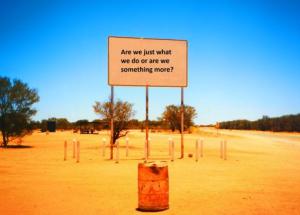
Are you what you do or something more?

I caught a glimpse of a new television commercial, I think for the Commonwealth Bank, featuring a man walking along a dusty road, whispering regrets to himself.

‘If only I would do something instead of just thinking about what I might do’ he says, or something like that.

Sounds like a carefully market-researched sentiment inserted into an emotive scene to echo what most people have thought at one point or another. Or continually.

Then the screen splits and a second, identical man is seen walking purposefully the opposite direction down a paved, tree and building lined road. The first man stops and stares after him.

The words ‘You are what you do’ fade on to the screen, along with the bank logo.

The implicit suggestion is that by associating with this bank, we will move from the ranks of the regretful thinkers to the have-it-all doers.

I don’t think so… If what we do is the sum of who we are, then we immediately dismiss those who can’t measure up – and ultimately that is all of us.

Read More »

Dear CheapBranded, thanks for your caring email…

My computer makes a doorbell sound, ‘ding-dong’, that used to be associated with Avon calling but is now better known as Windows default for a new email.

A shadowy preview of the new message appears in the lower right of my laptop screen and tells me it is from someone called ‘CheapBrandedViagra’.

(Just mentioning the word Viagra in my blog will send the spam protection software for this site into overdrive, such is the inter-connectedness – euphemism for lack of privacy – on the internet.)

A train of thought begins, thanks to my new friend CheapBranded, and I wonder if many of us realise how often we turn to the latest email, Facebook status, Twitter tweet or blog comment to fill deep emotional needs and stave of dreariness.

If our dearest friends are those who connect with us electronically, I have an amazing friend in CheapBranded as he has shown incredible determination to bypass not only my own spam protection, but that of my internet provider.

(I thought you should know I have worked with great commitment to avoid any unfortunate Viagra puns in this posting…)

But wait, perhaps CheapBranded is just that, not a caring friend who searched me out today with a loving email as my life faces precipitous change, but a cheap charlatan hoping to profit by pushing his brand at some perceived need.

Read More »

Tobacco tax hits the poor hardest

The increased cost of cigarettes is not just a tax or health issue, it is also one of justice and compassion.

The people hit hardest by the Rudd government’s 25 per cent increase on cigarettes, are the ones least able to afford it and the least able to choose the alternative – giving up.

There is little sympathy for smokers when tobacco is slugged with new taxes, the common cry being, ‘let them give up’.

But if you have grown up with smoking from before birth, had every significant person in your life as a smoker and if you have beaten off various other addictions with only nicotine to beat, that cry is offensive and simplistic. Add to this list social isolation, unemployment, mental illness, poverty and violence, and you might understand better why telling people to ‘just give up’ is not good enough.

I know many people who have, over a long period of time, beaten serious addictions, usually well after these addictions have destroyed their life. In almost every case, smoking is the one thing they cannot overcome.

When you live on a disability pension or minimum wage, are locked into nicotine addiction and with no sensible access to support for quitting, a new tobacco tax may as well be an arbitrary fine levied on you – just for being alive.

That’s why I’m urging support for independent South Australian Senator Nick Xenophon’s call to other Senators to block the Government’s recent tax hike on cigarettes unless more money raised from the tax is put towards helping smokers quit.

While the tax has already been introduced, it must be ratified by the Senate within 12 months. Senator Xenophon would like to see subsidies for nicotine patches, money for counselling services and more spending on health awareness campaigns.

‘My plea to the Government, to the Opposition, to my colleagues on the cross benches, is that just a little more money – in the vicinity of $100 million over the next four years, two per cent of this increase – could go a long way in assisting people to quit smoking for the Government to achieve its targets,’ he said.

So come on Mr Rudd, Mr Abbott, Mr Brown and Mr Fielding – do something for the least in our society to take another step towards a decent life.

If you put these resources in my hands, I’ll make sure those that really need them get the chance to give up and be free of this destructive habit. PH