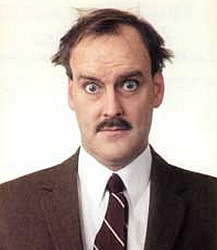
Monty Python‘s fish slapping skit (below) was described by John Cleese, speaking on Seven’s Sunday Night program, as the silliest skit the comedy group ever did.
But when it came to the funniest joke, he offered this, towards the end of the interview:
‘How do you make God laugh? You tell him your plans…’
He was commenting about whether he would be married for a fourth time. In context, the joke suggests that we know so little about what will actually happen in our lives that to tell God what we are planning is hilarious.
Most of the media coverage of the current debate over marriage-law portrays anyone who advocates for retaining marriage as it is, as a bigoted Neanderthal.
The reality is that many people have long and deeply held beliefs about marriage that were formed long before there was any debate about its fundamental nature. They didn’t wake up a month or two ago and say, “Oh, “I’m going to stick my neck out and believe that marriage is between one man and one woman”.
Neither did they decide that they would oppose marriage-law change because they hate or want to harm any person or segment of the community. It’s the debate on marriage-law that has moved and people are being asked to decide if they will move too.
For many people of faith, marriage is deeply entwined with fundamental beliefs about the nature of humanity, the expression of relationship and the very essence of God. It is not something on a bit of paper in isolation. That’s why, in many cases, the marriages of these people are among the most resilient in society – something they want to pass on to their children.
Whether we are a majority or minority is difficult to say. Whether marriage will be somehow harmed is yet to be seen. In the long run, the heart-felt belief of individuals in the context of a supportive faith-community and in relation with God is more important than any law, or anyone else’s view.
In the Parliament today, of the 30 members who spoke on marriage, 18 said an extraordinary majority in their electorates supported retaining the current definition of marriage, six said they favoured changed and six didn’t indicate the numbers in their electorate.
This does not equate to a large majority who are homophobic or hateful towards gay people, it is a large majority who hold certain beliefs about marriage, many for deeply personal or religious views. These are as valid as any of the populist, media-savvy voices that we hear.
Watching cars go round and round has never been a favourite pastime – I get enough of that in Sydney traffic – but as in every facet of human existence, there are personal stories embedded that make even Formula 1 racing interesting.
Asif Kapadia’s new documentary, Senna, tells one of these stories and while there is a fair bit of round and round, there is also an interesting investigation into the life, talent and faith of one of the sport’s most revered figures, Ayrton Senna.
The Brazilian Senna was a superbly talented, and some would say, a dangerous risk taker who had 41 wins and three World Championships which earned him the reputation of being one of the greatest Formula One drivers of all times.
He was well-known for his religious convictions which seemed to heighten for him as he raced.
“Somehow I got closer to God and this was very important to me. I visualized and saw God who is a part of me,” Senna said after one race. When reflecting on his love of racing, Senna says, “I think God gave me this chance.”
Frenchman Alain Prost, one of Senna’s key rivals, held an equally strong belief: that Senna’s personal companionship with the Deity made him a hazard to other drivers.
In one confrontation between the two, Prost says, “Ayrton thinks he can’t get hurt.” Senna responds, “Just because I believe in God does not mean I’m immortal. I know I can get hurt.”
The documentary shows the fulfilment of these words when Senna is killed in a crash in 1994 at the age of 34, while leading the field at the San Marino Grand Prix. The crash was caused by a mechanical fault and a camera strapped to his car continued to film throughout the tragedy.
Many people from all walks of life talk about the experience of feeling close to God when engaged in an activity that they sense to be their very specific calling and gifting. I once hear a rugby league winger say he felt he was born to score tries. As strange as it seems, maybe Senna was born to drive, and there was no other way to die.
Senna is showing now at Palace Leichhardt – check guides for other cinema times.
Speaking in tongues has finally come to ABC News as journalist Amy Simmons investigates why Pentecostalism is “attracting the Sunday masses” and examines the rise of Pentecostalism in a separate story.
The article covers some familiar territory – it seems each new generation of journalist keeps “discovering” the non-traditional traits that have made the Pentecostals the fastest growing Christian movement across the globe in the past century.
There’s plenty in the article to allow people to make up their own minds about Pentecostal churches and some areas of belief such as healing and speaking in tongues.
Of course, most Pentecostals would rightly point to Jesus as being at the centre of their beliefs and that without a clear understanding of and vital relationship with the Son of God, then the other elements of faith are worthless.
Academic Associate Professor Rick Strelan of the University of Queensland is called on to deliver the “objective expert” view and is reasonable in most of his comments, which is noteworthy in that Pentecostals are not overly accustomed to having their faith and practice discussed in a reasonable way.Read More »
After urging her young fans to let their voices be heard in support of gay marriage, Lady Gaga described herself as a traditional Catholic, in an interview with Tracey Grimshaw on Nine’s A Current Affair.
In a remarkable display of pluralism, Gaga saw no conflict with her ‘untraditional’ views on marriage and her identification with Catholicism.
Clearly Ms Grimshaw was less able to undertake the mental gymnastics required and began a line of questioning on religion by suggesting Gaga must be a lapsed Catholic.
Gaga laughed, saying she’d never heard the term and went on to explain she was very traditional, praying every day, praying before every concert.
She reminded her audience of her lyric that says “God doesn’t make mistakes” and linked her Catholicism to her Italian heritage, saying her parents had no objections to her music or concerts.
Overall Lady Gaga came across as an intelligent and talented young woman who displayed the prevailing post-modern views on morality, referring often to her song “I was born this way” as affirmation of people as they find themselves.
While agreeing with the positive impact of encouraging self-acceptance and tolerance of others, the logical extension of the view is the abrogation of personal responsibility allowing murderers and paedophiles to equally claim “I was born this way”.
At the same time, she made it clear that she had taken personal responsibility to change from being “hell on wheels” to having nothing to with drugs or to do anything to jeapardise the relationship she has with her fans.
It’s a rainy night on cold Norton St, but still plenty of diners and movie-goers are about. As I lift the edge of my umbrella to avoid colliding with two boys, one sliding on a wheel in his shoe, my vision slides across a poster and my brain computes iconic numbers and punctuation mark.
The advertisement on the back of a public phone pictures a Bible open to John’s third chapter.
The Australian is canvassing the issue of marriage but I wonder how many will recognise God’s shout-out to humanity contained in that ancient verse near the top of the pictured page.
‘For God so loved… gave his only… whoever believes… everlasting…’
If we don’t start there we’ll never understand anything else God has to say, about marriage or anything else.
Seeing the phrase “mission from God” on the front page of one of Sydney’s Sunday papers (June 26, 2011) sounds great until you realise it is a tongue-in-cheek reference to an evangelist crashing his car on the Pacific Highway after downing a few double-shots of Scotch.
Jason Hooper is an American evangelist touring parts of Australia with a New Zealand born Australian evangelist Ben Hughes. Hooper crashed into a parked Hyundai in Macksville and was found to have a blood-alcohol level of .206.
He later appeared in court and was disqualified from driving in NSW for three years but otherwise escaped penalty, much to the chagrin of locals, motoring organisations, the police and the Sunday Telegraph.
The magistrate took into account Hooper’s remorse and good character but the Telegraph was not impressed with Hooper’s reported claim that God had already forgiven him for his error.
And true to form with Sydney papers, the Telegraph found a way to inculcate Hillsong into the story saying that Hooper was touring with “Hillsong protegé Ben Hughes” – a claim that made it into the second paragraph.
As far as I can see, the only connection between Hughes and Hillsong is that he studied at Hillsong Leadership College at some stage, along with many thousands of other people. Keep in mind, Hughes has done nothing wrong and Hillsong isn’t even involved, so why were they mentioned?
It’s very unusual to see people defined by a place of study when describing traffic incidents. I don’t recall former-Judge Marcus Einfield being described as a “Sydney University protegé” when his traffic indiscretions were reported.
But to bring Jason Hooper and Marcus Enfield together for a moment – they both have learned the special retribution we save for people who make a career out of saying one thing, and then doing the opposite.
No wonder James in his New Testament letter warned against becoming a teacher because you would be “judged with greater strictness”. In both these cases, the men involved may have not been judged by the courts over-strictly, but certainly they will be by the public and the media. (Einfield has had another traffic scrape this week.)
A good reason to remain humble, accountable and realistic about your state of well-being – and driving! And let’s hope the next time God get’s a mention on the front page, it’s for something positive…
The inevitable failure of Harold Camping’s prediction that the world would end on Saturday, May 21 once again confirms the infallibility of Jesus’ own words about his return.
Knowing that we would be inclined to want to pin down his return to a day and hour and knowing that people like Harold Camping would claim to do just that, Jesus said (2000 years ago), ‘No one knows about that day or that hour…’ (Matthew 24:36).
Knowing that earthquakes, disasters and wars would start us thinking that perhaps the end of the world was near and knowing the advent of instant worldwide communication would mean we hear about more earthquakes, disasters and wars than ever before, Jesus said, ‘You will hear of war and rumours of wars, but see to it that you are not alarmed. Such things must happen, but the end is yet to come… famines and earthquakes in various places… the beginnings of birth pains.’ (Matt 24:6,8)
Knowing that people would try to cash in on the uniqueness of Christ and claim to be him, such as the recently publicised Alan Miller, and knowing that many are desperate for a tangible, physical sense of hope and will follow these false Christs, Jesus said, ‘…if anyone says to you, “Look, here is the Christ!” or “There he is!” do not believe it.’ (Matt 24:23)
And knowing that many who were among the first to hear the message of the Gospel would forsake it; the Western world for example, which has grown so fat and comfortable and clever in its own eyes, Jesus said, ‘at that time many will turn away from the faith… increase of wickedness… love of most will grow cold’. (Matt 24: 10,12)
Thank you Harold Camping for confirming once again that Jesus’ insight into human character and history is impeccable, infallible, believable.
God is once again assisting British scientist Stephen Hawking to receive world-wide media publicity, even though Hawking is saying nothing new.
In an ‘exclusive’ interview in Britain’s Guardian newspaper on May 16, Hawking said there was ‘no heaven or afterlife… that is a fairy story for people afraid of the dark.’
The author of international best-seller A Brief History of Time admitted his views were influenced in part by his long fight with motor neurone disease.
‘I regard the brain as a computer which will stop working when its components fail.’
Hawking’s has moved from a position where belief in God was not necessarily at odds with a scientific understanding of the universe – as expressed in A Brief History of Time – to one where God no longer has a place in theories on the creation of the universe – expressed in his 2010 book The Grand Design.
Baroness Susan Greenfield, one of England’s most distinguished scientists, said in response to Hawking’s (and other scientists’) comments on God: ‘Yes I am [worried]. Of course they can make whatever comments they like but when they assume, rather in a Taliban-like way, that they have all the answers then I do feel uncomfortable. I think that doesn’t necessarily do science a service.’
So before you throw away your Bible and consider yourself nothing more than a computer on legs, check out these responses to Stephen Hawking.
Alan John Miller, 47, met Mary Luck, 32, in the lounge room of her parent’s home. The only thing unusual is that Alan makes straight-faced claims to be Jesus Christ and says Mary Luck is really Mary Magdalene who just happened to be living nearby. The Apostle John, a first century disciple of the historical Christ, is also living in Australia, according to Alan Miller.
Miller says that there are probably a million people who say they are Jesus Christ and ‘most of them are in asylums. But one of us has to be. How do I know I am? Because I remember everything about my life.’
Interviewed tonight (May 16, 2011) on A Current Affair, Miller came across as reasonable, calm and gentle (oh, there was that small thing about meeting Elvis) and several of his followers were interviewed and clearly have a strong belief in his messianic claims.
Up to 40 people have moved to the tiny town of Wilkesdale near Bundaberg and hold meetings on a 16 ha property, where they plan to build an international visitors centre. This is despite claiming Alan does not desire a following.
Of course where there is a Jesus claim, there are also miracle claims as well. News outlets are reporting that a giant cross has been inadvertently created by land clearing near the cult’s property.
‘In a bizarre coincidence, land clearing has created a giant cross on neighbouring properties that can be seen from space using Google Maps. Local residents insisted it was not carved deliberately,’ News Ltd reports.
And while Miller says that all he wants to do is communicate Divine Truth that people can choose to accept if they want, he seems to be ignoring the truth of the first century Jesus who warned his followers about false Christs.
‘At that time if anyone says to you, “Look, here is the Christ!” or, “There he is!” do not believe it. For false Christs and false prophets will appear and perform great signs and miracles to deceive even the elect — if that were possible. See, I have told
you ahead of time.
‘So if anyone tells you, “There he is, out in the desert,” do not go out; or, “Here he is, in the inner rooms,” do not believe it. For as lightning that comes from the east is visible even in the west, so will be the coming of the Son of Man.’ Matthew 24:23-27Read More »
The Bishop of London, the Right Reverend and Right Honourable Dr Richard Chartres gave a stirring Address at the wedding of Prince William of Wales and Miss Catherine Middleton.
Billions around the world heard Rev Chartres urge William and Catherine and all listening to set the world on fire by being who God meant us to be.
He also highlighted that every wedding is a royal wedding in the sense that every bride and groom are kings and queens of creating new life.
Rev Chartres said that in marriage we are to make our spouse our ‘work of art’ while at the same time not placing on them a burden of expectation that only relationship with God can carry.
Interestingly, the sermon included a prayer composed by William and Catherine which asks God’s help in keeping their eyes fixed on what is real and important and to help them to be generous with their lives, ‘to serve and comfort those who suffer’.
Read the full sermon:
‘“Be who God meant you to be and you will set the world on fire.” So said St Catherine of Siena whose festival day it is today. Marriage is intended to be a way in which man and woman help each other to become what God meant each one to be, their deepest and truest selves.
‘Many are full of fear for the future of the prospects of our world but the message of the celebrations in this country and far beyond its shores is the right one – this is a joyful day! It is good that people in every continent are able to share in these celebrations because this is, as every wedding day should be, a day of hope.
In a sense every wedding is a royal wedding with the bride and the groom as king and queen of creation, making a new life together so that life can flow through them into the future.Read More »
The European name for the area known as Trinity Beach, far north Queensland, originates from Captain James Cook’s exploration of Australia in 1770.
He passed by this section of coastland on or near Trinity Sunday, June 10, 1770. The traditional owners of the region are the Gimuy Yidinji.
It is the first time possibly in my life that I did not attend a church service over Easter but being surrounded by family and God’s preaching through creation, ensured a deeply spiritual experience.
A band of cloud crosses the reflected light of the moon producing the image of a cross. The light also produces a key-hole shape.
After a cross-shaped image created by the full moon on Good Friday, Easter Sunday's sunrise did not fail to bring a powerful feeling of resurrection.
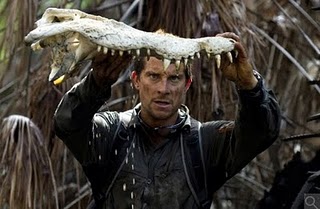
Bear Grylls featured on Channel 7’s Sunday Night program tonight where besides eating spiders and leaping out of helicopters, he was also shown visiting Hillsong last weekend.
Admitting that speaking to an auditorium full of people is scarier than most of his Man vs Wild adventures, he also revealed how he got his nick-name, Bear.
Rather than arising from ‘wrestling a bear when I was 3’, Grylls explained that his real name is Edward, which was shortened to Ted, and then Teddy, on to Teddy Bear and finally just Bear.
So one of the world’s toughest men is named after a soft toy…
Described on the show as a ‘man of God’, Grylls once again acknowledged the importance of Christian faith in his life and the importance of prayer.
For more on Bear Grylls and his views on God, visit my previous Bear post. He also has his own blog where he describes making a show in an Australian swamp as one of his hardest yet. You might also like to visit the charity page on the blog, and see how he uses his fame and fortune.
Speaking of which, he said fame and fortune were two things that caused him the most trouble which may be why he supports so many charities.
Oh, and the worst thing he’s eaten was a toss-up between raw goat testicles and bear poo…
So, I’ve had a very long case of writer’s block. More writer’s coma than block. More writer’s near-death experience than coma. More…
Anyway, I’m just searching for that sweet-spot of an idea for what to do next. Don’t tell me, I’ll get it eventually.
In the meantime, it did spark my interest that the 7pm Project discussed falling church attendances tonight. Tellingly, they quoted no hard statistics, quoted a minister from a denomination with famously declining membership due to its abandonment of faith, and quoted an atheist who is too young to have any idea if there is a God or not because he hasn’t lived long enough to have a single conviction tested. Or so it seemed to me.
Host Carrie Bickmore admitted her mother had dragged her along to Hillsong, Steve Price had the usual hackneyed response about churches and money and Hughesy said that if it makes people happy and gives them good values then what’s the problem. The too-young-to-know atheist pondered what would happen without the community that religion provides, but failed to give an alternative.
Oh, and by the way, on a different note, I’m reading my first Ernest Hemingway book, Death in the Afternoon, which is non-fiction and about bullfighting… well, it was the only Hemingway available at Leichhardt Library – but already I’ve gained a few insights into his approach to writing, which may or may not be a good thing.
Sitting in a Christmas Eve service I was enjoying a short film from the kids of St Paul’s in New Zealand, when a phrase spoken by one of the children went off in my head like a gun.
‘Jesus had two daddies, God and Joseph…’
While people sometimes stumble over the paternal origins of Jesus, the children who made this Christmas film had no trouble accepting that there were, in some sense, two fathers in Jesus’ life.
And why would the kids of today have trouble with this concept when so many of them live with this reality, and even more complex ones.
In the work in which I’m currently involved, I spend much of my time with children and young people coming to terms with a constellation of adults who represent mother and father figures to them.
It is particularly difficult at times for foster children, who find themselves in a loving foster home with carers they regard as their mummy and daddy, while at the same time having regular contact with other people who are, in many cases, equally loving parents.
It is one of the main challenges of child protection globally to know how to resolve this issue in a healthy and a whole way, for the benefit of the child. It rarely is easy and often encounters incredible difficulties.
Hundreds and thousands of foster children will be faced with this dilemma this Christmas season and how well they negotiate it will depend a lot on the selflessness and security of the adults involved.
Then there is that other broad category of children who have multiple parental relationships – those from families touched by divorce.
Perhaps for the first time it occurred to me, during the Christmas eve service, that Jesus had found yet another way to identify with the heartache of this world – represented by the complexity of having two dads.
I know it’s different, and I know having God for a dad is unique, but in the moment that child spoke these words, ‘Jesus had two daddies’ I knew many children would feel happy to hear that they were not alone in working this out.
For many years I have attended church and was aware of and in touch with global poverty, local disadvantage, the ravages of substance abuse and the struggle of mental illness, but I had scant knowledge of the hundreds and thousands of children balanced in the fulcrum of parental responsibility. Who has responsibility for them – mum and/or dad? Uncle and/or aunt? The government and its delegated foster carers? Or have they taken responsibility for themselves at far too tender ages?
Jesus had two dads who both took responsibility for aspects of childhood wellbeing. We live in a time when more and more children are finding their parents will not or cannot take responsibility for them. These are rarely clear-cut or easy decisions.
Stepping into this breach are a range of government and non-government caseworkers, relative and foster carers trying to replicate the love and belonging of birth family, something that is remarkably hard to do. And yet many do it well – and deserve special recognition and thanks.
So if you are going to pray this Christmas, spare a line or two for kids with too many parents or too few; for parents who have lost their kids and can’t seem to work it out; for carers who are family and those who are not, who raise kids with love; and for government and non-government workers who try to put this stuff together, usually with not a thanks to be found. Happy Christmas. Jesus had two daddies too…
A radio advertisement in Australia for the new Gran Turismo 5 PlayStation 3 computer game, has the following dialogue (paraphrased):
‘Hello, I’m God, and I made the world in seven days – look how awesome it is! Gran Turismo 5 took five years to make, think how awesome it must be!’
Two positives:
#1 God is acknowledged as Creator.
#2 You don’t have to shoot, maim or kill anyone in Gran Turismo – just drive the car of your dreams. Most be a lot of car lovers out there as the game sold more than 2.5 million units in its first week.
Plenty of interesting things have been found on Google Street View ranging from dead bodies to hovering cars, but perhaps even God has made an appearance.
A god-like figure can be seen hovering midair above a lake in Quarten, Switzerland.
Discovered by the Gawker blog, the image is most likely to be the result of light distortion or lens flare, however blogger Max Read has questioned tongue-in-cheek whether it might have more mysterious origins:
‘Is it something on the camera lens? Or is it maybe… God and His only begotten Son? And who’s to say that God isn’t “something on the lens”, in some kind of a cosmic, metaphysical sense?’ he writes.
God can be anywhere and everywhere – even on a camera lens no doubt – which kind of reminds me of the supposed ‘how many angels on the head of a pin‘ theological debate. Still, when God appears again in the sky, the Bible suggests we won’t be left guessing…
And let’s not forget Perth’s famous hovering cars or an unusual man-made landscape in a remote part of China which appears to be a model of a larger piece of territory complete with snow-topped mountains, streams and valleys.
It’s snowing on Utterance, a WordPress nod to Christmas. But as we are in the southern hemisphere, and the weather is decidedly warm and damp, I think we can describe it as ‘slow rain’. If you don’t know what I’m talking about, it may be time to upgrade your computer…
Image via Wikipedia
And some trivia for a slow, wet Saturday afternoon… I wrote a story about Masterchef and the seven deadly sins on July 11 and since then it has recorded 2,109 world-wide hits. That’s a lot of people reading an article that ends with this comment:
The message – however much we have been sinned against, forgiveness can be greater. Obviously, we can turn that around and say that however many times we have sinned, God’s grace is sufficient to bring forgiveness – if we sincerely receive it.
The problem is that if we do not acknowledge the existence of sin – a widespread modern phenomenon – we will not access God’s forgiveness. In this case, if sin does exist , despite our disbelief, we remain unforgiven.
Most people visiting the article have used an internet search related to seven deadly sins or terms such as ‘gluttony’.
Another very popular post relates to Bear Grylls and his Christian faith – about 1,700 readers in five months. Grylls says this about his faith:
‘Christianity is not about religion – it’s about faith, about being held, about being forgiven. It’s about finding joy, finding home.’
When Jesus told his small band of followers that they would make him known to the ends of the earth, he unleashed a socio-spiritual revolution that continues to change our world today.
And the message they would carry was that as we learn to love God, love our neighbour and love ourselves – in that order – a new community of grace and truth is possible.
These largely uneducated and insignificant disciples never conceived of this mission and the community it would produce as being possible apart from a living encounter with the words and very reality of Christ himself.
On Monday, Tim Flannery released his new book Here on Earth: An Argument for Hope and some of what he proclaims sounds eerily similar to the mission proclaimed by Jesus, but with a new god at its core.
An extract from the book appeared in Saturday’s Sydney Morning Herald under the heading, ‘To the ends of the earth we must go’ – either an accidental or deliberate recalling of Christ’s words.
And while the focus of the extract is human responsibility for causing – but also potentially repairing – environmental degradation, there is a deeply spiritual tone to the article.Read More »
The trappings of Christianity are precisely that, a trap – just ask Teresa Lewis or Mary MacKillop.
When we adhere outwardly, publicly or religiously to Christian faith but deny its inner, personal change, eventually we – and others – are snared in a trap of our own making.
What tends to happen is that the appearance of being a good Christian becomes an ever broadening disguise, hiding the real turmoil within. We would have been better to deny the appearance and be honest about the reality.
As guilt and condemnation do their insidious work, and as we have more to lose if our charade is exposed, we work harder on the exterior, becoming even more lost on the inside.
Jesus gave the simple example of the religious leader coming to pray, full of hubris, flaunting his religious superiority but in reality being further away in God’s eyes than the scorned tax collector who stood at a distance, ashamed of his wrong-doing, and seeking mercy and forgiveness.
Extreme examples in today’s world come to light with the execution of a US woman and the one-time excommunication of soon-to-be-Catholic-saint, Mary MacKillop.
Teresa Lewis was executed in Virginia on Friday afternoon (AEST) fo arranging the killings of her husband and a stepson over a $US250,000 insurance payment.
Amazingly, Lewis had the appearance of a strong Christian and even prayed with her husband in bed before getting up and unlocking the door of their home to let in the killers.
The Sydney Morning Herald reports that Lewis admitted her life had been marked by outrageous bouts of sex and betrayal even as she ‘hewed to the trappings of Christianity’.
‘I was doing drugs, stealing, lying and having several affairs during my marriages,’ reads a statement by Lewis. ‘I went to church every Sunday, Friday and revivals but guess what? I didn’t open my Bible at home, only when I was at church.’
Which is why a Christian life marked only by ‘meetings’ is not a true marker of discipleship. Jesus said that while we would find his presence in the company of other believers, so too among the poor, in serving others and in a heartfelt searching of our own hearts.
Mary MacKillop by all accounts was someone known for these qualities which is no doubt why she was responsible for exposing the paedophilia of a priest, and then excommunicated for her troubles.Read More »
 Monty Python‘s fish slapping skit (below) was described by John Cleese, speaking on Seven’s Sunday Night program, as the silliest skit the comedy group ever did.






















 utterance