How to handle Halloween and engage with our culture

Just as Christmas is one of the rare occasions (other than the deliverance of Chilean miners) when there is public reference to Jesus, God, the Holy Spirit and angels, so too Halloween is increasingly a time for the mention of demons, spirits and the devil.

Whether it is small boys wandering supermarkets with the devil’s pitchfork, as I ponderously witnessed last week, or  a television weather presenter claiming to be surrounded with demons and spirits, Halloween is to the Christian an unnerving public foray into the dark side of the supernatural.

Most know little of Halloween’s history – how the church long ago sought to supplant a Celtic pagan festival that honoured the dead with a festival to remember the saints – All Hallow’s Day (preceded by All Hallow’s Eve – Hallowe’en). The battle for the spiritual heart of the occasion is still up for grabs.Read More »

Farewell institutional power, hello grassroots influence

Sermon on the Mount by Bloch. Image: Wikipedia

Churches have probably lost the fight against the NSW Government’s plan to introduce ethic classes in public schools at the same time as optional special religious education.

Education Minister Verity Firth is glowingly positive about the review of the classes and while there are no plans to remove SRE, the once ‘sacred’ right to offer Scripture without competition in NSW public schools will soon be a thing of the past.

Of course this is a manifestation of a wider truth that the church has lost much of its institutional power and perhaps in the future will lose even more.

There are positives though and the main one is that if churches and Christians learn they can’t rely on a privileged institutional role in society, they may finally revert to the ancient source of Christian vitality –  personal and community transformation through offering real life encounters with a living God.

This of course can’t be done any other way than through authentic relationship and engagement with people of all kinds.

Grassroots influence verses institutional authority – which one sounds more like Jesus?Read More »

Greens love cafes, asphalt and euthanasia

‘If you travelled on a Sunday you would notice, as you moved out from the inner city to the outer suburbs, that the church services attract bigger crowds. Conventional religious belief is stronger. This explains why these electorates do not warm to the Green agenda of euthanasia, abortion, gay marriage and adoption. The fascinating thing about Green supporters is that their natural habitat is not the open spaces or the pristine forests but the crowded cafes and asphalt alleys of high-density, inner-city living.’ Peter Costello writing in the Fairfax press today.

It’s not the first time this inner city Green phenomenon has been pointed out but the first time since the Greens held the balance of power in the Senate, and to some degree, in the House of Representatives.

A few suggestions – more churches in the inner city; a viable alternate political party with strong environmental and social justice policy that more closely reflects Christian views in other areas; think, engage, critique and comprehend the culture in which you live.

If love is value, how do we make it real?

Sy Rogers is a Christian minister, married father and a man who lived as a woman for two years in preparation for a sex change operation.

Around that time, as he ventured into an average American church, he learned something of the real meaning of love, a message he shared in Sydney on the weekend, some 20-30 years on.

Feeling that the word ‘love’ has been over-used and stripped of meaning – we love our family but also love our new shoes – he replaced it with the word ‘value’.

‘For God so valued the world, the he gave His only Son…’ or ‘Greater value has no one than this, that they lay down their life for their friends’. 

He said love – or his definition for it – value, is delivered, communicated or made real to others through three things:

1. Acceptance – which says ‘I’d rather have you messy than not have you at all.’ Because someone is valuable to God and valuable to us, we accept them as they are. This is where love/value begins.

2. Accountability – which says ‘because you are valuable I won’t leave you where you are, but hold you accountable towards a better day’. It’s the kind of accountability that doesn’t leave a friend playing dangerously on a busy highway, but says ‘ for your own good, because your valuable to me, get off the road’.

3. Affirmation – which says ‘I’m going to show you that your valuable, not just by what I say, but by how I treat you.’ Affirmation is when we communicate that what happens to someone we love, matters to us – rejoicing with those that rejoice, and weeping with those that weep. We need affirmation because of insecurity – ‘a fancy word for fear, a fear that says “I doubt my value”‘.

May your day be full of the giving and receiving of acceptance, accountability and affirmation because you are of great value!

Jesus is still a dangerous idea…

Stained glass at St John the Baptist's Anglica...
Image via Wikipedia

The Festival of Dangerous Ideas is on again at Sydney Opera House on October 2-3 covering everything from The Right is the New Left through to that most important of questions, Are All Men Fakes?

But before we take a closer a look at the festival (tomorrow), I recall discovering a dangerous idea when I was at university studying humanities back in the early eighties.

That was a time when Australia still had an active communist party and I think most of its members were either studying or lecturing in my course.

It might also explain why one of the subjects on offer was Studies in Rebellion and I was just rebellious enough to take it.

Then while most of my comrades where sliding to the left politically or dallying deeply into capitalism, I became a Christian and began volunteering in a soup kitchen.Read More »

How to cast the perfect vote… and not cast the first stone

Australian and I Vote
Hands up who votes for Australia?! Image by Stephen Mitchell via Flickr

Many Australian voters will be hoping to cast the perfect vote on Saturday – one that represents the best policies, the best candidates and the best future for themselves and the nation.

Christians, and many other thoughtful people, are trained to be intentional and purposeful in all that they do, conscious of rights and wrongs and doing what is best in the eyes of God or their own conscience. This brings a kind of moral pressure to bear as we sift through the competing arguments from candidates and commentators alike.

Sometimes casting a vote almost becomes a battle to see who will cast the first stone – is there any among us worthy to pass judgement on the poor, political sinners scrambling exposed in the dust?

The hard, but relieving, truth is that the perfect vote does not exist, and never has because none of the parties or candidates are perfect. So if perfection is your goal, your are looking in the wrong place. I can think of Someone perfect, but He doesn’t need your vote. He would appreciate a chat though…

So take the pressure off, sit back and read my summary of the various options based on years of journalism and a relentless reviewing of parties, policies and posting more than 110 articles on the election in the past two months. 

 Oh, and one thing I won’t be doing is telling you how to vote… That’s your decision.

Visit Australian Christian Voter to read the full article.

Related Articles

Chattering and tractoring classes worlds apart on election day

In the inner Sydney seat of Grandyler where I live we have as a choice of candidates, starting on the left:  two varieties of socialists, the Greens, a rare Democrat sighting, the sitting Labor member and a Liberal candidate who is so young that the picture of youths being sent off to war as canon-fodder comes to mind.

Compare this to, say, the rural NSW seat of Riverina and you have, starting at the right: One Nation,  Independent, Christian Democratic Party, Family First, Liberal Democrat, Nationals, Liberals, Labor and Greens although there may be some discussion as to the relative ‘rightness’ of some of these candidates.

In other words, we have remarkably different worlds just a few hundred kilometres apart. It’s a common divide between the city and the bush and grows wider with relative distance from major city CBDs.

While there are overlaps and exceptions, we would do well to understand and respect the differences in priority and perspective between the inner city ‘chattering classes’ and the rural ‘tractoring classes’. 

One lesson is that the Greens have taken a step up from being a minor party that falls into an organisational hole when elections drawn near. They are mobilised even in electorates where they have more chance of being mistaken for a vegetable than winning.

If parties such as the CDP or Family First aspire to real political influence they must find their support base, represent it powerfully and broadly and do the hard yards of political foot soldiering.

As for making sense of it all, an election article of mine has been published in Sight Magazine or visit my Australian Christian Voter blog to find a link and vote in an election day survey – what’s your tip for election day?

Dying while bringing sight to the blind

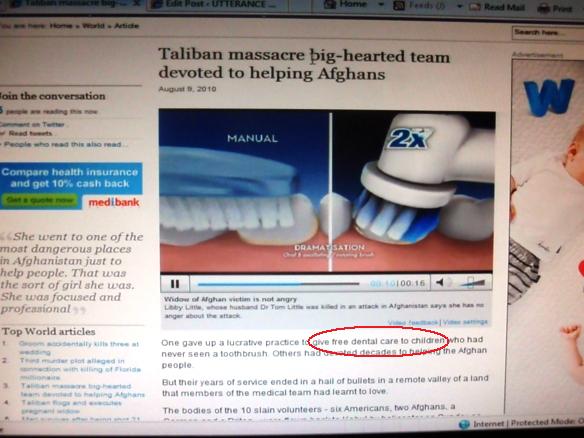
The headline read ‘Taliban massacre big-hearted team devoted to helping Afghans’ and accompanying the written report was a video featuring the widow of one those killed.

Before the video plays, on the SMH online site, it is preceded by an advertisement for electric toothbrushes.

The team killed in Afghanistan was providing basic medical care, including eye and dental care and one of the workers was a dentist who had handed out thousands of toothbrushes over the years, to children who had never seen one.

This juxtaposition reminds us of the implausible position we in the west too often take – that our wealth and freedom has no connection to another’s poverty  and restraint.

This post is in honour of the six Americans, two Afghans, a German and a Briton who were slaughtered on August 8.

Many of them were Christians, most having given up their life in the west to embrace life in Afghanistan so they could be an example of kindness and goodness.

Read the full report here.

Watch the video report (minus toothbrush ad) and particularly note the response of widow, Libby Little, as she calls down God’s mercy on those who killed her husband.

Read the full statement about the deaths from International Assistance Mission, the Christian organisation for whom the team worked. This is an example of a deeply committed, intelligent, genuine Christian response to the world’s poor.

Asking the poverty question.

Christians get moving on election action

We’ve passed the half-way mark of the election campaign and the temperature could be rising just a little.

Waking a bit groggily this morning, the result of working split night shifts so that my already insomniac tendencies are exacerbated, I heard a promo for ABC Radio’s AM in which a determined-sounding woman was telling the reporter she wouldn’t be voting for Julia Gillard because she’s an atheist and she knew ‘hundreds of people’ who had the same view.

You can check out this story at Australian Christian Voter.

As if to keep the ball rolling, the Australian Christian Lobby launched its Australia Votes website today and once again you can get a good rundown  at ACV.

Finally, candidate electorate forums are up and running, check out a list of the ACL ones organised so far.

Or perhaps you would prefer the Make Poverty History/Micah Challenge variety. Learn about them here.

Social engagement not just for the few

Scott Stephens is probably a good bloke doing a hard job, as editor of ABC Online’s Religion and Ethics portal.

But his July 19 blog post pretty much wrote off any Christian that engaged in politics (except maybe those he agrees with) and was full of stereotyping, arrogance and perhaps a slight trace of envy.

We are all good at that, if we are honest, aren’t we? So lets pray for him as on balance it is a positive thing that such a forum exists and a Christian is the editor.

His post attacking the Australian Christian Lobby, and among other things, Hillsong, gave the impression that unless you are a trendy, left-wing intellectual who reads Eureka St you shouldn’t climb the ivory tower of social engagement for fear of embarrassment.

That’s a pity because what we really want to do is educate Christians about social engagement, for the sake of the gospel, and the best way to do that is for us all to have a go, get kicked in the head a few times, learn some lessons, grow in humility and wisdom, and keep going…

Check out my response to his post.

Are we missing the very frontline of faith?

The Australian community is engaged in an extremely active and vigorous debate about the reality of God and I’m not sure the church at large is even aware it is going on.

While we faithful pray in our services and gatherings that God would move in our land, we may be missing the very answer to those prayers. (Try and stay with me my atheist readers, I know your blood pressure just rose at the mention of answered prayer.)

One of the first signs of spiritual revival might well be that people are even thinking about first order issues such as the origins and nature of life, is there supernatural or spiritual reality or only a material universe, and if religious claims are true how do we deal with many apparent contradictions and problems.

These kinds of questions are often and vigorously debated mainly in online forums and often in response to an increasing number of articles in the media addressing these questions from one perspective or another.

I can assure you this was not the case 10 or 20 years ago when most Australians didn’t want to discuss faith at all and where apathy and materialism (in this sense of material gain) seemed far more important.Read More »

Faith shines, undaunted by broken bodies

I have witnessed holy moments this week, acts of faith largely unseen but shining brightly in an invisible kingdom. They have left me humbled and undone. The first I witnessed personally, the second through the eyes of others.

Standing in a rehabilitation hospital I am surrounded by septuagenarians and find myself playing the role of the younger generation, nice for a change.

The first stood, fire in his voice, to pray for his friend sitting in a wheelchair. The pray-er has this year come through life-threatening emergency surgery to remove a massive tumour that was destroying his spine. Remaining full of faith throughout, he feels more qualified to pray for healing, not less.

He wags his finger lovingly at his friend who finds herself in a wheelchair after tumbling down a cliff, breaking her neck and bruising her spinal column.  

‘Don’t ever think that God wouldn’t want to heal you just because you are old. He loves you unconditionally and wants you to have life to the full,’ he says. Read More »

Politicians fail to deliver on asylum seeker policy

Check out some comment on the asylum seeker issue I’ve made on my other blog, Australian Christian Voter.

Christians, along with just about every other section of the community, are divided about how best to respond to the arrival of refugees by boat.

The politicians have no hope of coming up with cohesive policy because they are playing to political audiences. But Christians are often not much better, sniping at each other from behind entrenched views.

If a forum of Christians across a variety of perspectives could provide a united voice, we might actually lead the nation in a prophetic way. We need national Christian leadership to do this – it’s there I’m sure but where do we find it? PH

Mother reminds world of Justin’s Christian origins

“No 15-year-old wants to be around his mother 24/7. And no mother wants to be around her 15-year-old 24/7, either.”

Sounds like a pretty down to earth comment really and the interesting thing is that it was made by Pattie Mallette, the mother of 16-year-old pop star, Justin Bieber.

Ms Mallette has been in the news this week for reminding the world of her son’s Christian origins. In a discussion about the star’s commitment to remain a virgin until marriage, his mother said, ‘He’s expressed his desire to stay pure, and honour women, and treat women with respect. So hopefully that stays valid.’

Apart from the slightly obscene aspect of the world discussing a 16-year-old’s virginity, it is an intersting insight into ridiculous fame crashing headlong into real people in real family.

Pattie Mallette was just 18 when she became pregnant with Justin, who was born on March 1, 1994, in Stratford, Ontario. She worked low paying office jobs as she raised Justin as a single mother.

While Justin taught himself  to play the piano, guitar and trumpet by the age of 12, Pattie began posting videos of his performances on YouTube with a clear strategy in mind.

It seems that she had a strong Christian faith and at some point, as many parents do, had in a very real way ‘given’ her son over into God’s hands, seeing him as a possible modern day prophet Samuel.Read More »

Julia learned Bible verses but formed different views

Faith in politics is much more on the agenda in Australia than it was a decade ago and so it is no wonder there has been intense interest as to the religious convictions, if any, of new Prime Minister Julia Gillard.

Today she was directly questioned about religious faith and the future of the Christian vote in Australia during an interview on ABC Radio.

The Australian newspaper reports that Ms Gillard appeared to be ‘surprised’ when asked whether she believed in God and how she would court the Christian vote.

‘I’m not a religious person,’ Ms Gillard told the ABC, although she was quick to point out she had won a prize for learning Bible verses as a child in the Baptist Church. ‘I’ve, you know, found a different path.’

Read more of what she had to say at Australian Christian Voter.

How will Julia Gillard appeal to Christian voters?

Julie Gillard’s rise today to Prime Minister came just a few days too late for the thousands of Christians who watched Kevin Rudd and Tony Abbott perform in the Make it Count webcast on Monday night.
Now it is back to the drawing board for Christian voters with a new Labor leader and Christian leaders, churches and commentators will be anxious to see where Gillard stands on various issues of importance to the Christian community.
Learn more about our first female and first foreign-born Prime Minister at Australian Christian Voter.

God dethroned, humanity is next

The ABC’s Q and A program last night gave a rare display of the logical outcome of secular humanism.

Having begun discussing the relative merits of saving whales verses chickens, the show ended, under the guidance of unethicist Peter Singer, considering that it might not be so bad for humans to have sexual relations with their pets.

While most people on the panel and in the audience couldn’t even engage with that outrageous final topic, it did show us where popular secular thinking is taking us.

Having dethroned God, the next logical step for secular atheism is to dethrone humanity. If there is no God to say that human life is sacred, made in His image, then people are just animals, right and wrong mean nothing and euthanising children and oral sex with dogs is acceptable.

If you don’t believe me, read the transcript. It happened on national television and while hugely offensive, was at least an honest viewing of the dismal trajectory of the thinking of Singer and the secularists.

If you have been flirting naively with some of their ideas, take a good look at the whole murky monster and flirt no more.

From Hughesy to Fielding and everything in between

There’s plenty happening at Australian Christian Voter. You can watch a good collection of political videos ranging from Dave Hughes trying to keep a straight face while convincing people to register through to Senator Stephen Fielding telling his life story.

You’ll learn how Christians are lobbying hard at the seat of power and even get a chance to vote on the question: Which party/parties represent the best value for Christian voters?

A valuable resource (if I do say so…) with a federal election not far away. Check it out.

Ethic classes – ‘new atheism’ in poor disguise

As the debate rages over the trial of ethic classes as an alternative to Scripture in state schools, those in favour of the new program ask, in a smugly reasonable tone, ‘Why can’t the churches respect parents’ right to choose?’

As if that is all that is really at stake. As if this is really just about a choice between your child going to Scripture, ethics or having a half-hour break.

What it is really about, and why some churches are fighting so hard, is the final and complete secularisation of public schools, fueled by the rampant new atheism which views religion as poison.

No matter what politically correct sounding arguments emerge from both camps, at stake is the privilege of access to public schools.

The goal of the new ethic classes is to so threaten the status and viability of Scripture that it will eventually disappear.

Of course the Minister for Education will never say that, in public, nor the proponents of ethic classes. But you can hear it slipping through in an odd angry shot at the Anglicans or the Catholics during media debates, and it is rampant in the unofficial grassroots commentary.

My children attended a school that did not have Scripture, in which recognition of Easter and Christmas was completely secular. Christmas carols were out, ‘seasonal songs’ were in.

Parents of faith often felt under siege and so desolate was the atmosphere of the place, I eventually pleaded to be allowed to organise an assembly that in a light-hearted way, told the real Christmas story.  One half hour in an entire year…

So what is at stake is not so much the to and fro over Scripture and ethics. It is the choice between a completely secular atheistic system or one where there is some decent recognition that people of faith exist.

But we shouldn’t be surprised by these battles. The secularisation of society has been raging for many years and, in reality, the institutional power of the church (which gave it the right to Scripture classes) has long been in decay.

Christian commentators such as Joel Edwards of Micah Challenge have said that the church needs to accept the demise of institutional power, and take up the opportunity of grassroots influence.

Newer churches, such as the Pentecostals, have never had institutional power which is why they have been so much better at grassroots influence.

Maybe the way to win the current battle, is for Scripture and the Christian communities of inner city to be so vibrant, so alive, so full of grace and power, so full of kindness and generosity and love, so authentic in relationships across dividing lines, that instead of relying on ancient privilege, they benefit from a new invitation to participate in schools, organisations and communities… PH

Shroud evidence delights believers and sceptics in turn

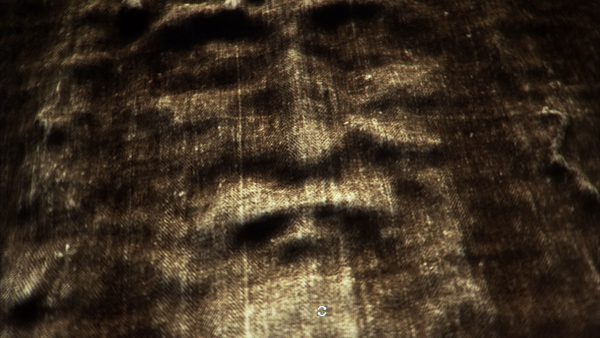
The 2D Shroud image transformed by 3D computer graphics

Weeks after posting a story about new three-dimensional imaging of the Shroud of Turin, Utterance continues to field search inquiries about the Shroud from around the world.

Fascination with this enigmatic cloth apparently never ends and no doubt has been heightened with the Shroud’s first public display in 10 years having just ended at the Cathedral of St. John the Baptist in Turin.

Another factor is the quest for faith or unfaith as some seek in the Shroud evidence of Jesus’s reality while others continue the quest to disprove him.

While Christ’s reality does not hinge on the authenticity of the Shroud of Turin (there are many other historical evidences), it is still a powerful symbol of faith for millions of Christians and a ‘thorn in the flesh’ for secular atheists.

Two recent Shroud findings are split between supporters and detractors. 

Read More »