An attempt was made to list on Wikipedia an article about Alan John Miller, the Australian man claiming to be Jesus who was featured on A Current Affair this week.
The article was deleted due to a lack of substantiation and references, however a discussion sprang up on a forum about the article, mainly among people concerned about relatives who have begun to follow Miller’s Divine Truth teaching.
Part of Miller’s technic is to reach searching people through a course called Alpha Dynamics, which ostensibly is about improving the use of your brain in relation to concentration, memory and better sleep. It also draws on New Age references to alpha and beta waves. The course is coordinated in Australia by Peter H. Heibloem.
As the course progresses, attendees are pushed towards the ‘real answer’ to their worries, Divine Truth, as taught by, you guessed it, Alan Miller.
Coincidentally, or perhaps not, one of the most popular training courses being run by Christian churches recently is called Alpha and while it has nothing to do with Alpha Dynamics, there is potential for confusion.
For example, a person who contributed to the forum (mentioned above) expressed his concerns for friends entangled with Miller and refers to Alpha training.
God is once again assisting British scientist Stephen Hawking to receive world-wide media publicity, even though Hawking is saying nothing new.
In an ‘exclusive’ interview in Britain’s Guardian newspaper on May 16, Hawking said there was ‘no heaven or afterlife… that is a fairy story for people afraid of the dark.’
The author of international best-seller A Brief History of Time admitted his views were influenced in part by his long fight with motor neurone disease.
‘I regard the brain as a computer which will stop working when its components fail.’
Hawking’s has moved from a position where belief in God was not necessarily at odds with a scientific understanding of the universe – as expressed in A Brief History of Time – to one where God no longer has a place in theories on the creation of the universe – expressed in his 2010 book The Grand Design.
Baroness Susan Greenfield, one of England’s most distinguished scientists, said in response to Hawking’s (and other scientists’) comments on God: ‘Yes I am [worried]. Of course they can make whatever comments they like but when they assume, rather in a Taliban-like way, that they have all the answers then I do feel uncomfortable. I think that doesn’t necessarily do science a service.’
So before you throw away your Bible and consider yourself nothing more than a computer on legs, check out these responses to Stephen Hawking.
On the day a frustrated father protested on the Sydney Harbour Bridge over access to his children, I finished a nearly nine month stint as a Community Services caseworker.
Although Mick Fox’s grievance centred on custody arrangements after divorce, Community Services, forever to be known as DoCS, was also a target of his outrage.
A former girlfriend said, ‘I was with him for a lot of the time when he was trying to get in contact with DOCS [the Department of Community Services] and the police, purely because his kids were in danger every day.’
However the police and even the Minister for Family and Community Services Pru Goward denied it was a case in which Community Services were involved.
Without commenting on this particular case, it is sometimes one of the less attractive strategies of battling partners in divorce and custody cases to ring the child protection Helpline to accuse the other party of harming the children.
For a child protection system already stretched to the limit, these calls are always investigated thoroughly but soak up the precious time of caseworkers.
And so the day began on that dramatic note and proceeded to by a relatively typical day for my final one as a caseworker. Read More »
‘Yes, even with a pretty, naked girl, full-frontal male nudity, prostitution, drugs and casual sex, Sleeping Beauty turns out to be very slow and a little dull.’
Sounds like a commentary of popular western culture really… but in fact is a review of Australian feature Sleeping Beauty which premiered at the opening night of Cannes Film festival this week.
The film, starring Emily Browning, is the work of Australian first-time director and novelist Julia Leigh and may well prove, yet again, that simply being willing to push the boundaries of what will be shown on-screen is not the same as making a good movie.
Or maybe it is a deliberately boring movie to show that the debauched lives it portrays are empty of anything vital and lively.
The mentally ill are the most invisible of sufferers in our society and this has often been reflected in government policy and funding.
Having worked for years at a grassroots level with the chronically mentally ill, there are few issues I feel more strongly about than increasing support for people with mental illness, their families and those who care for and treat them.
Keep reading to see what Treasurer Wayne Swan said about his mental health funding initiatives in tonight’s 2011 federal budget speech.
And check some early response to the announcement in this report from the ABC. It qualifies Mr Swan’s announcement by showing that the funding is slow to be rolled out and there will be other losses along the way.
The Sydney Morning Herald has taken a cheap shot at Hillsong and the Seventh Day Adventist church by linking them to federal budget legislation that ‘will put a lid on the practice of so-called charities using their tax-free status to generate business income for no charitable purpose whatsoever.’ (SMH, May 11, pg 4)
The story reports on changes to legislation expected in Tuesday’s budget which will require not-for profit organisations to pay tax on profits kept for commercial purposes.
The article then lumped Hillsong and the Seventh Day Adventist Church into that category: ‘The Hillsong church has links with the Gloria Jean’s coffee shop franchise, while the cereal company Sanitarium is owned by the Seventh Day Adventist Church.’
The SMH has been like a rabid conspiracy theorist in relation to Gloria Jeans and Hillsong for some time and failed again to acknowledge or understand that the fact that the owner of Gloria Jeans attends Hillsong does not equate to the church owning the business. Hence the nebulous ‘has links’ in the article. If every charity or church is to have its tax status changed because it has ‘links’ with a business, then most would be impacted.Read More »
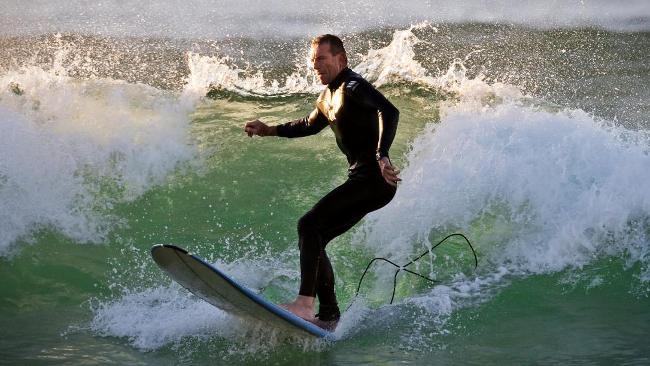
The coverage of Opposition leader Tony Abbott’s surfing lesson with former refugee Riz Wakil focuses heavily on the ‘political dialogue’, with most media outlets using exactly that term courtesy of AAP’s report.
And while there was indeed a sharp political edge to the event, due to the Federal Government’s current bungling efforts to come up with their own ‘non-Pacific-solution-Pacific-solution’, I am more interested to learn if there was any ‘personal dialogue’ between the two men.
It is amazing what can happen when we get to know someone from another stream of life. Our tightly held prejudices, misunderstandings, ignorances and apathies often fall away.
Many differences in society could be resolved if opposing sides actually got to know one another as real people rather than stereotypical objects.
This was an opportunity for such an interaction to occur, but at this stage, the only reports show two men shoring up their so-called political agendas.
‘Mr Abbott can teach me a thing or two about surfing, and I’ll teach him about what refugees go through to build a new life in Australia,’ Mr Wakil was reported as saying before the event.
Likewise, Mr Abbott was widely reported as looking forward to the surfing lesson largely because of the political mileage he would gain amidst the Government’s woes.
When we see people in the Middle East rejoicing in the streets over the death of Westerners in a terrorist attack, we feel outraged. We struggle to understand the world view that would cause one person to celebrate the needless death of another.
And while it may be a poor comparison, seeing Americans cheering in the streets over the death of Osama bin Laden doesn’t sit well with me either. While it could be argued that his demise is a justified casuality of war or a just result for a terrorist, surely it is still an overwhelmingly sad moment.
Sad that it continually comes to this in human history – someone must die for others to feel safer, freer, stronger.
15th century depiction of Cain and Abel
I don’t judge those that are cheering – so many were touched by the 9/11 attacks and many other tragic killings around the world, it is understandable that there would be a sense of relief and victory and yes, even celebration.
But in the cold light of day, people will soon realise that the world’s problems, America’s problems, have not gone away and the struggle that has gripped humanity since Cain and Abel goes on unabated.
President Obama said that people who love peace and human dignity would welcome bin Laden’s death. Maybe so.
But only One Man’s death has ever truly provided for peace and human dignity in a profound, eternal and ultimate way. And his undeserved death was for thieves, murderers and, yes, scandalously, even terrorists.
See how some of America’s Christians are responding:
There has been some comment that Anzac Day on April 25 trumped Easter Sunday on April 24 with the SMH reporting that, ‘Media Monitors says there were 1878 mentions of the word Anzac in broadcast media over the long weekend, compared to only 44 resurrections.’
The unusual conjunction in the Australian calendar of the two ‘key foundation stories’ meant that the devout may have found themselves at a dawn service two days in a row!
No doubt coverage of Anzac Day did outstrip Easter commemorations, one reason being that most Anzac Day events took place out in the community with a degree of effort taken to ensure everyone was made welcome to attend. In many case Easter services took place behind church walls with the uninitiated left to work out for themselves how to attend.
For example, holidaying a long way from home, we received invitations both verbal and written, to the Anzac Dawn Service in the small town in which we stayed but were left to search Google to see if there was a church within walking distance. There wasn’t.
It may be that in some cases, the church has given up trying to make the amazing message of Easter accessible to all while momentum for Anzac Day continues to grow. I would say – more power to Anzac Day, but those of us who know the power of Easter truth should not be afraid of taking our joy outside in genuine, unself-conscious and welcoming ways.
The Divine may yet have the last headline in any case. Media commentators may not be aware, but in many Anzac Day commemorations, large and small, around the nation, Christian ministers are invited to give the address and invariably draw comparisons between the self-sacrifice, giving of life and courage embedded in Anzac Day and likewise in the Christ of Easter.
There is nothing closer to a national Christian service than Anzac Day, even though it is a secular event. The sentiments expressed are often as close to the Christian message as they two days were on the calendar this year.
Whatever interest there has been in the Royal Wedding to this point, it has almost been overshadowed by one small act of affection, the Royal Kiss.
As much as people have been caught up in the pageantry, celebrity and history of the Royal Wedding, humanity seems to crave even more the intimacy, reality and spontaneity of two people touching lips to show their love.
Prince Charles and Princess Diana were the first royal couple to kiss on the balcony of Buckingham Palace, and it is rumoured that Charles first paused to ask permission of the Queen, which was duly granted.
Now William and Catherine have given their own romantic demonstration, as if to anoint the vows that went before, accompanied by the oohs and aahs of a couple of billion television viewers.
Many television commentators, swept along by the great sense of good ‘will’ accompanying the wedding, have spoken of the couple as carrying with them the hopes of a new generation and a renewed era.
But a marriage is more than a wedding service and balcony kiss (or two), and hopefully William and Catherine have taken time to learn the lessons of the past and will find their way to live with wisdom, balance, faith and, as their prayer from the wedding mentioned, generosity.
So, I’ve had a very long case of writer’s block. More writer’s coma than block. More writer’s near-death experience than coma. More…
Anyway, I’m just searching for that sweet-spot of an idea for what to do next. Don’t tell me, I’ll get it eventually.
In the meantime, it did spark my interest that the 7pm Project discussed falling church attendances tonight. Tellingly, they quoted no hard statistics, quoted a minister from a denomination with famously declining membership due to its abandonment of faith, and quoted an atheist who is too young to have any idea if there is a God or not because he hasn’t lived long enough to have a single conviction tested. Or so it seemed to me.
Host Carrie Bickmore admitted her mother had dragged her along to Hillsong, Steve Price had the usual hackneyed response about churches and money and Hughesy said that if it makes people happy and gives them good values then what’s the problem. The too-young-to-know atheist pondered what would happen without the community that religion provides, but failed to give an alternative.
Oh, and by the way, on a different note, I’m reading my first Ernest Hemingway book, Death in the Afternoon, which is non-fiction and about bullfighting… well, it was the only Hemingway available at Leichhardt Library – but already I’ve gained a few insights into his approach to writing, which may or may not be a good thing.
That famous Australian Christian institution, beach mission, is covered favourably in Sun and salvation make a divine holiday for fun-seeking souls. And while this generous portrayal may be a pleasant surprise, it is unsurprising that David Marr has dug up some criticism of the highly acclaimed school chaplaincy program. Read his article (and what about sending in a letter to the editor in response?), Chaplains in schools are ‘inadequately supervised’.
It may be a new year, but the struggle in which all the world is involved, of ideas, reality, relationships and the true nature of personhood and love, continues unabated.
Sitting in a Christmas Eve service I was enjoying a short film from the kids of St Paul’s in New Zealand, when a phrase spoken by one of the children went off in my head like a gun.
‘Jesus had two daddies, God and Joseph…’
While people sometimes stumble over the paternal origins of Jesus, the children who made this Christmas film had no trouble accepting that there were, in some sense, two fathers in Jesus’ life.
And why would the kids of today have trouble with this concept when so many of them live with this reality, and even more complex ones.
In the work in which I’m currently involved, I spend much of my time with children and young people coming to terms with a constellation of adults who represent mother and father figures to them.
It is particularly difficult at times for foster children, who find themselves in a loving foster home with carers they regard as their mummy and daddy, while at the same time having regular contact with other people who are, in many cases, equally loving parents.
It is one of the main challenges of child protection globally to know how to resolve this issue in a healthy and a whole way, for the benefit of the child. It rarely is easy and often encounters incredible difficulties.
Hundreds and thousands of foster children will be faced with this dilemma this Christmas season and how well they negotiate it will depend a lot on the selflessness and security of the adults involved.
Then there is that other broad category of children who have multiple parental relationships – those from families touched by divorce.
Perhaps for the first time it occurred to me, during the Christmas eve service, that Jesus had found yet another way to identify with the heartache of this world – represented by the complexity of having two dads.
I know it’s different, and I know having God for a dad is unique, but in the moment that child spoke these words, ‘Jesus had two daddies’ I knew many children would feel happy to hear that they were not alone in working this out.
For many years I have attended church and was aware of and in touch with global poverty, local disadvantage, the ravages of substance abuse and the struggle of mental illness, but I had scant knowledge of the hundreds and thousands of children balanced in the fulcrum of parental responsibility. Who has responsibility for them – mum and/or dad? Uncle and/or aunt? The government and its delegated foster carers? Or have they taken responsibility for themselves at far too tender ages?
Jesus had two dads who both took responsibility for aspects of childhood wellbeing. We live in a time when more and more children are finding their parents will not or cannot take responsibility for them. These are rarely clear-cut or easy decisions.
Stepping into this breach are a range of government and non-government caseworkers, relative and foster carers trying to replicate the love and belonging of birth family, something that is remarkably hard to do. And yet many do it well – and deserve special recognition and thanks.
So if you are going to pray this Christmas, spare a line or two for kids with too many parents or too few; for parents who have lost their kids and can’t seem to work it out; for carers who are family and those who are not, who raise kids with love; and for government and non-government workers who try to put this stuff together, usually with not a thanks to be found. Happy Christmas. Jesus had two daddies too…
It’s snowing on Utterance, a WordPress nod to Christmas. But as we are in the southern hemisphere, and the weather is decidedly warm and damp, I think we can describe it as ‘slow rain’. If you don’t know what I’m talking about, it may be time to upgrade your computer…
Image via Wikipedia
And some trivia for a slow, wet Saturday afternoon… I wrote a story about Masterchef and the seven deadly sins on July 11 and since then it has recorded 2,109 world-wide hits. That’s a lot of people reading an article that ends with this comment:
The message – however much we have been sinned against, forgiveness can be greater. Obviously, we can turn that around and say that however many times we have sinned, God’s grace is sufficient to bring forgiveness – if we sincerely receive it.
The problem is that if we do not acknowledge the existence of sin – a widespread modern phenomenon – we will not access God’s forgiveness. In this case, if sin does exist , despite our disbelief, we remain unforgiven.
Most people visiting the article have used an internet search related to seven deadly sins or terms such as ‘gluttony’.
Another very popular post relates to Bear Grylls and his Christian faith – about 1,700 readers in five months. Grylls says this about his faith:
‘Christianity is not about religion – it’s about faith, about being held, about being forgiven. It’s about finding joy, finding home.’
Hundreds of thousands of Australians will sing Christmas carols this month at services and events organised by Christian churches.
It is a great point of connection for churches and the community and many of the carols are deeply spiritual songs that proclaim core Christian truths such as the deity of Jesus.
And while for many Australians it will be the only time in the year that they actually give voice to the faith they hide in their hearts, there is a discussion among church leaders as to what carols are actually appropriate.
The decision not to sing Jingle Bells at a Christmas service may seem fairly obvious; whether to sing Away in a Mangermay not be as clear.
Christianity Today has a discussion going on the use of Christmas carols and some issues have been raised which, frankly, never crossed my mind, and I’ve sung a few carols in my time.Read More »
In some parts of country Australia, such as western NSW, it has been at least five years since there has been a harvest of any note.
The land at its people have been oppressed by a stubborn failure of rain for up to a decade.
Ironically, the challenge this year has been too much rain with flooding meaning some farmers have missed out again.
Thankfully blue skys and a warming sun are prevailing for now, allowing harvesting to begin.
The west feels profoundly different, as if the pain of past years has been washed away by renewing rains or buried beneath a mountain of multiplying grains. The birds are more abundant and even tired old trees have dressed up in the latest green shoots of spring.
I am from the city but have been deeply moved in the presence of a paddock standing thick with wheat, the wind rustling the golden stalks like a happy, dancing wraith.
While there is much yet to do before farmers will feel their harvest is safely finished, this magnificent return to reaping what you sow is a massage to the heart.
There’s a rightness to it that challenges the cynical unnaturalness, or fakeness, of so much recent thinking.
Return to hope, return to the basics of love and truth and growth and new life. Return to God, the author of it all.
Hollywood Jesus no doubt started out as a genuine attempt to engage with popular culture but is now dangerously close to blasphemy, certainly in regard to its Santa Paws at Your Church “sweepstake”.
A promotional email sent out by Hollywood Jesus, a US Christian movie website, invites readers to enter a ‘Santa’s BFF (best friends forever?) contest in which first prize is a visit by Santa Paws, a free screening of the movie and DVD give-aways. Check it out:
The church does need to engage with culture and to communicate in a language that touches the heart and souls of real people.
But there is a place for purposeful discernment – what are we trying to achieve and what do we risk losing by gaining some temporary popularity? And probably we should ask, who is making money out of it?
When I first saw this email I felt sure it was a hoax, with a virus hiding behind every link. Or perhaps the Chaser boys had sent it out to see how many tacky Christians they could snare.
But it’s real and sincere and obviously no one involved saw a problem with it. And unless you pull back and ask, who is meant to be influencing who at Christmas time, or anytime, it might just slip by as another great way to get lots of unchurched families dropping into the church building to have a great old time.
Except what kind of Jesus could really be communicated in the sickly-sweet company of Santa Claus (or Paws), Walt Disney, Hollywood and good old American (and Australian) consumerist tripe!Read More »
Just as Christmas is one of the rare occasions (other than the deliverance of Chilean miners) when there is public reference to Jesus, God, the Holy Spirit and angels, so too Halloween is increasingly a time for the mention of demons, spirits and the devil.
Whether it is small boys wandering supermarkets with the devil’s pitchfork, as I ponderously witnessed last week, or a television weather presenter claiming to be surrounded with demons and spirits, Halloween is to the Christian an unnerving public foray into the dark side of the supernatural.
Most know little of Halloween’s history – how the church long ago sought to supplant a Celtic pagan festival that honoured the dead with a festival to remember the saints – All Hallow’s Day (preceded by All Hallow’s Eve – Hallowe’en). The battle for the spiritual heart of the occasion is still up for grabs.Read More »
When Jesus told his small band of followers that they would make him known to the ends of the earth, he unleashed a socio-spiritual revolution that continues to change our world today.
And the message they would carry was that as we learn to love God, love our neighbour and love ourselves – in that order – a new community of grace and truth is possible.
These largely uneducated and insignificant disciples never conceived of this mission and the community it would produce as being possible apart from a living encounter with the words and very reality of Christ himself.
On Monday, Tim Flannery released his new book Here on Earth: An Argument for Hope and some of what he proclaims sounds eerily similar to the mission proclaimed by Jesus, but with a new god at its core.
An extract from the book appeared in Saturday’s Sydney Morning Herald under the heading, ‘To the ends of the earth we must go’ – either an accidental or deliberate recalling of Christ’s words.
And while the focus of the extract is human responsibility for causing – but also potentially repairing – environmental degradation, there is a deeply spiritual tone to the article.Read More »
Sy Rogers is a Christian minister, married father and a man who lived as a woman for two years in preparation for a sex change operation.
Around that time, as he ventured into an average American church, he learned something of the real meaning of love, a message he shared in Sydney on the weekend, some 20-30 years on.
Feeling that the word ‘love’ has been over-used and stripped of meaning – we love our family but also love our new shoes – he replaced it with the word ‘value’.
‘For God so valued the world, the he gave His only Son…’ or ‘Greater value has no one than this, that they lay down their life for their friends’.
He said love – or his definition for it – value, is delivered, communicated or made real to others through three things:
1. Acceptance – which says ‘I’d rather have you messy than not have you at all.’ Because someone is valuable to God and valuable to us, we accept them as they are. This is where love/value begins.
2. Accountability – which says ‘because you are valuable I won’t leave you where you are, but hold you accountable towards a better day’. It’s the kind of accountability that doesn’t leave a friend playing dangerously on a busy highway, but says ‘ for your own good, because your valuable to me, get off the road’.
3. Affirmation – which says ‘I’m going to show you that your valuable, not just by what I say, but by how I treat you.’ Affirmation is when we communicate that what happens to someone we love, matters to us – rejoicing with those that rejoice, and weeping with those that weep. We need affirmation because of insecurity – ‘a fancy word for fear, a fear that says “I doubt my value”‘.
May your day be full of the giving and receiving of acceptance, accountability and affirmation because you are of great value!




 ‘Mr Abbott can teach me a thing or two about surfing, and I’ll teach him about what refugees go through to build a new life in Australia,’ Mr Wakil was reported as saying before the event.








 utterance